Spider Plant Care: A Beginner's Guide
Everything you need to grow a thriving spider plant: light, water, humidity, propagation, and the real reason your tips keep browning.
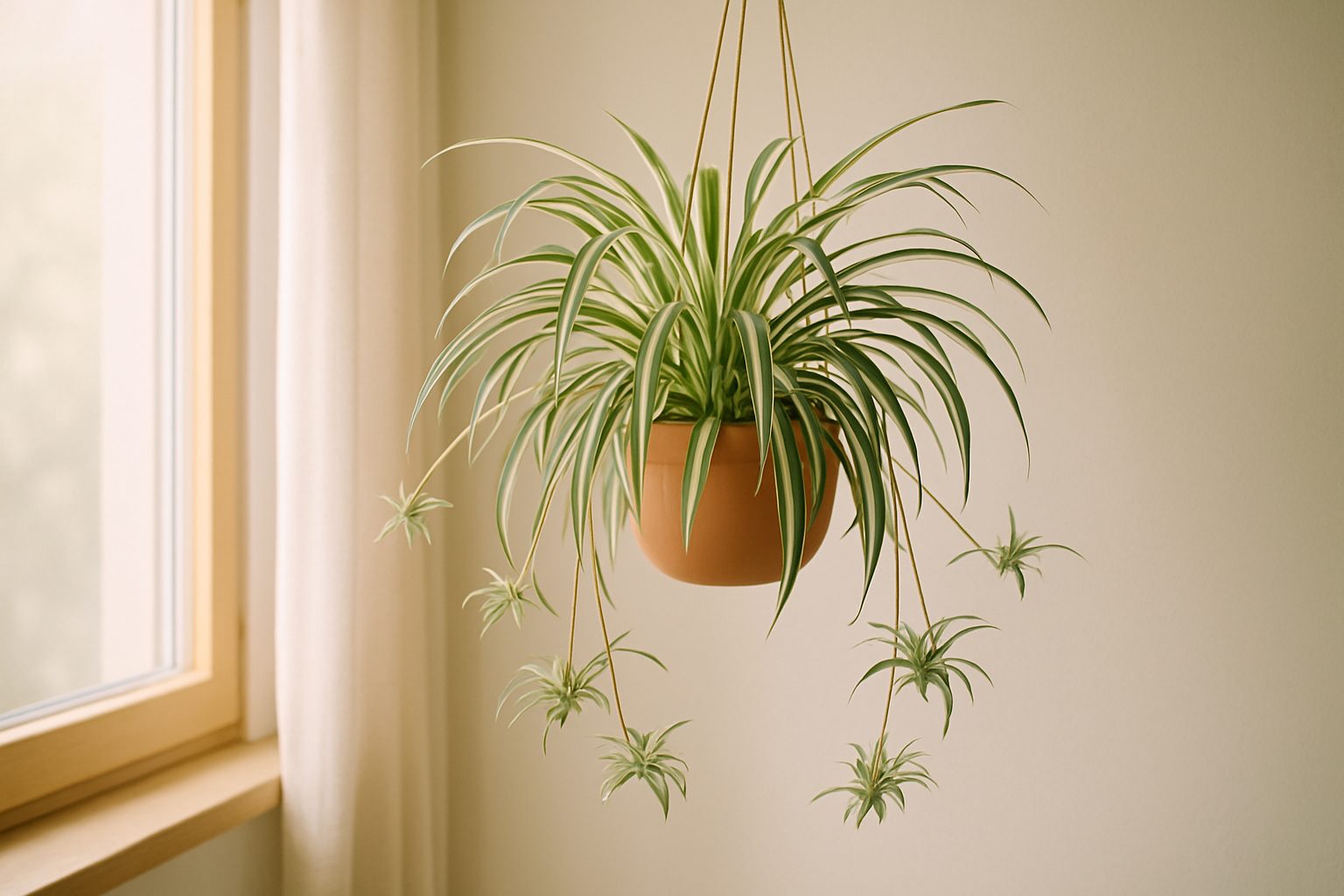
Spider plant care is forgiving, but “forgiving” is not the same as “impossible to get wrong.” Most problems come down to water quality and humidity, two things almost every guide glosses over. Get those right, and your plant will reward you with cascading runners full of babies.
Quick answer: Spider plants need bright indirect light, water every 1 to 2 weeks (letting the top inch of soil dry first), well-draining potting mix, and moderate humidity around 40 to 60%. The brown tips nearly everyone complains about usually come from fluoride or chloramine in tap water, not overwatering.
Spider Plant Care at a Glance
| Factor | What it needs |
|---|---|
| Light | Bright indirect; tolerates medium light |
| Water | Every 1 to 2 weeks in summer, every 2 to 3 weeks in winter |
| Soil | Well-draining all-purpose potting mix |
| Temperature | 60 to 80°F (15 to 27°C) |
| Humidity | 40 to 60% |
| Fertilizer | Monthly April to October; pause in winter |
| Repotting | Every 1 to 2 years, or when roots fill the pot |
Common Varieties
Spider plants come in a handful of cultivars, all with the same care needs:
- Vittatum: the classic. Green center stripe with white edges.
- Variegatum: reversed coloring: white or cream edges with a green center. Slightly wider leaves.
- Bonnie: curly, spiraling leaves. More compact than the standard varieties.
- Reverse Variegatum: all-white center with green edges. Less common in garden centers.
If your stripes are fading or disappearing, that’s usually a light problem (covered below). It rarely has anything to do with the variety.
Light
They do best in bright indirect light, near a north- or east-facing window, or a few feet back from a south or west window. They tolerate lower light, but “tolerate” is the honest word. In dim conditions, growth slows, variegated leaves lose their white or cream stripes as the plant pushes out more chlorophyll, and babies stop appearing.
A few hours of gentle morning sun is fine. Harsh afternoon sun through glass will bleach or scorch the leaves.
If your apartment is genuinely dark, a full-spectrum LED grow light on a 12-hour timer, positioned 12 to 18 inches above the plant, keeps things healthy without any dramatic setup.
Water
Water when the top inch or two of soil is dry. In summer, that usually means every 7 to 14 days. In winter, stretch it to every 2 to 3 weeks. There’s no fixed schedule that works for every home. Check the soil and let it tell you.
Overwatering vs. underwatering: how to tell them apart. Both make leaves limp and droopy, which confuses beginners constantly. Check the soil directly: wet, dense soil that smells musty points to overwatering. Bone-dry soil pulling away from the pot edges means underwatering. Yellowing lower leaves with soggy roots confirm overwatering. Brown, papery tips with completely dry soil confirm underwatering.
For a fuller watering framework you can apply to all your plants, see how often to water houseplants.
If root rot has already developed, our guide to root rot in houseplants explains how to diagnose and save the plant.
Why tap water causes brown tips
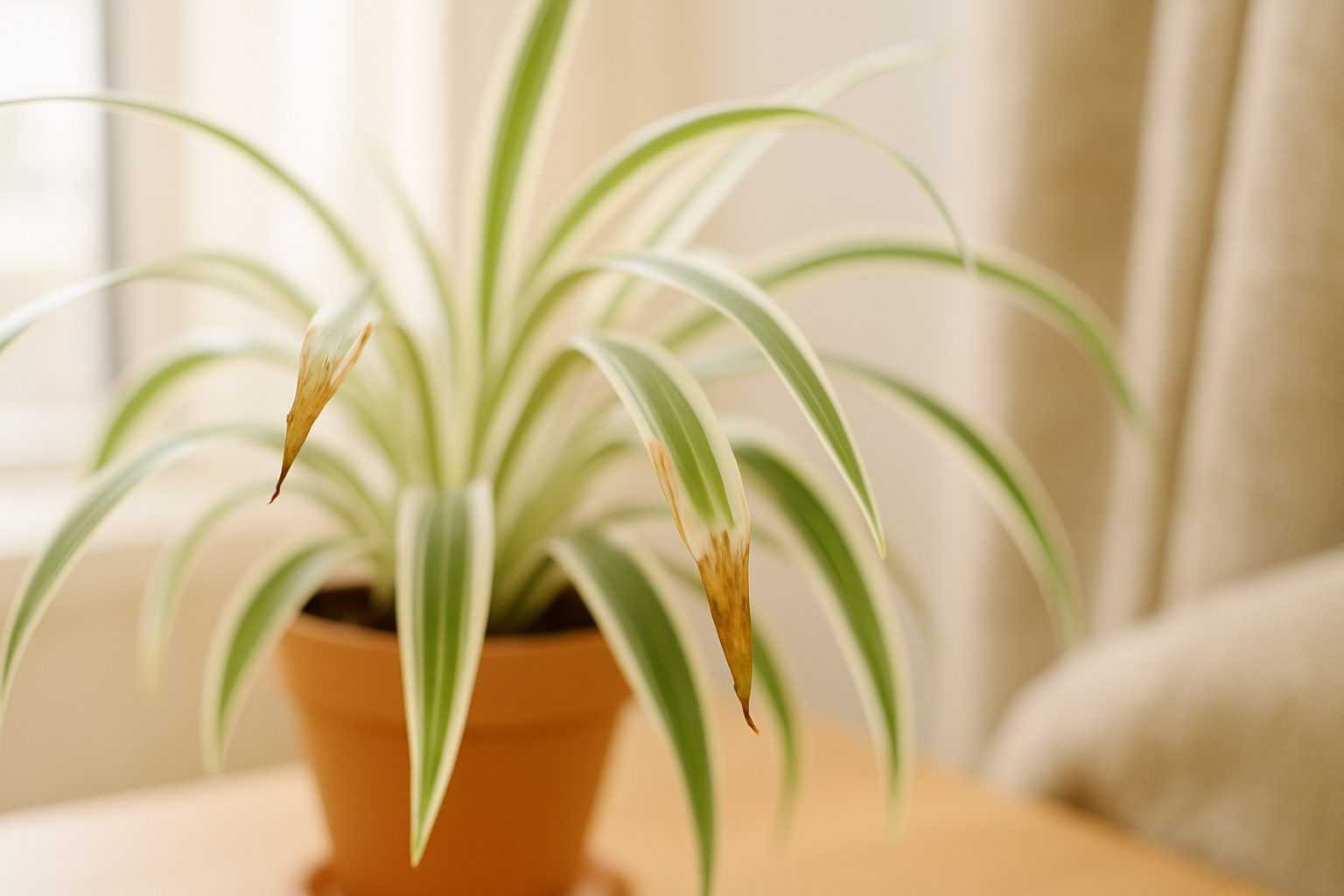
Spider plants are sensitive to fluoride and certain treatment chemicals in municipal tap water. Over time, these accumulate in the soil and cause the classic brown tip problem that watering adjustments alone will never fix.
Use filtered water, collected rainwater, or distilled water when you can. If that’s not practical, fill your watering can the night before and leave it uncovered overnight. This allows chlorine to off-gas.
But many water systems now use chloramine instead of chlorine, and chloramine does not off-gas. So if the overnight method hasn’t helped your brown tips, that’s probably why. Check your local utility’s water quality report, and if it says chloramine, filtered or distilled water is the only real fix.
Soil
A standard well-draining potting mix is all you need. “Well-draining” means water runs through it quickly rather than staying soggy. If yours tends to hold too much moisture, mix in a handful of perlite (those small white pellets) to improve drainage.
Avoid heavy garden soil. It compacts in pots and stays wet. And use a pot with drainage holes. Good soil can’t compensate for nowhere for the water to go.
Temperature and Humidity
Spider plants are comfortable at 60 to 80°F (15 to 27°C), which covers most normal indoor temperatures. They don’t like frost, cold drafts, or temperatures below 50°F (10°C), so keep them away from drafty windows once nights turn cold.
Humidity is where most people fall short. Spider plants prefer 40 to 60% relative humidity. Heated homes in winter often drop below 30%, and that’s when tips go crispy, edges brown, and growth stalls out.
Practical ways to raise humidity around your plant:
- Set the pot on a tray of pebbles and water. The water evaporates upward around the plant.
- Group it near other plants, which raises local humidity naturally.
- Run a small humidifier nearby in winter.
Getting humidity right is often the single change that solves brown tips, crispy edges, and slow growth all at once.
Fertilizer
Feed once a month from April through October with a balanced liquid fertilizer, diluted to half the recommended strength. That’s the whole routine.
Skip fertilizing in winter. Feeding a slow-growing plant leads to salt buildup in the soil, which makes brown tips worse. And extra fertilizer won’t speed up growth. It just burns the roots.
Repotting
Spider plants are one of the few houseplants that genuinely do better slightly rootbound. When roots run out of room, the plant shifts energy away from growing new leaves and toward reproduction, which is why a cramped pot triggers runners and plantlets. Repot too early and you short-circuit that process.
The right time to repot is when roots are visibly circling the bottom of the pot, the plant is pushing itself upward out of the pot, or it dries out extremely fast after watering. Move up just one pot size (about 2 inches wider).
Spring is the best time. Use fresh well-draining mix.
Propagation
Once the plant is mature (usually 1 to 2 years old) and slightly rootbound, it sends out long arching runners with small plantlets at the tips. These are your free plants.
In water: Cut a plantlet from the runner and place it in a small jar of water with just the base submerged. Roots appear within 1 to 2 weeks. Pot it up once the roots are about an inch long.
Directly in soil: Cut the plantlet and press it into moist potting mix. Keep the soil slightly moist for the first two weeks while roots establish.
One thing nobody warns you about: newly propagated plantlets often go through an ugly phase. They may droop, look pale, or lose a leaf while adjusting. This is normal. Don’t assume you’ve done something wrong. Give it a couple of weeks.
You don’t need a runner to have formed yet. Plantlets root just as well cut early.
Common Problems
Brown tips. The most common complaint. Usually caused by tap water chemistry, low humidity, or inconsistent watering. Switch to filtered or distilled water, raise humidity, and water on a consistent schedule. Trim brown tips with clean scissors at a slight angle to match the natural leaf shape. New growth will come in clean. For a full breakdown, see spider plant brown tips.
No babies. Spider plants produce runners when they’re slightly rootbound and getting enough light. If you’ve been repotting frequently or keeping it somewhere dim, both of those work against baby production. Hold off on repotting and move it closer to a window.
Yellow leaves. Most often overwatering or early root rot. Check the soil: if it’s wet and smells off, let it dry completely before watering again. See how to rescue an overwatered plant if you think the roots are affected.
Fading variegation. White or yellow stripes turn green in low light. The plant is compensating for less light by producing more chlorophyll. Move it closer to a window and new growth will come back striped.
Pests. Spider mites show up as fine webbing with tiny moving dots. Mealybugs look like white cottony fluff in leaf joints. Scale appears as small hard bumps on stems. If you spot any of them:
- Isolate the plant from your other plants immediately.
- Wipe down all leaves with a damp cloth to remove as many pests as you can.
- Treat with neem oil solution or insecticidal soap, covering every surface including leaf undersides.
- Repeat every 5 to 7 days for 3 to 4 weeks to break the egg cycle.
- Return it to your collection only once you’re confident it’s clear.
A note on air purifying
Spider plants have a well-earned reputation as air purifiers. The original research was a NASA study from 1989, conducted in sealed chambers at pollutant concentrations far higher than any normal home. In a real room with air exchange, the effect is real but modest. A spider plant will not transform your indoor air quality on its own, but it won’t hurt either.
A note on cats
The ASPCA lists spider plants as non-toxic to cats and dogs. That said, cats are strongly attracted to them and will chew on the leaves. Eating a significant amount may cause mild vomiting or stomach upset. If your cat treats it as a snack bar, keeping it out of reach is the practical solution.
Spider Plant Care FAQ
How often should I water a spider plant?
Every 7 to 14 days in spring and summer, every 2 to 3 weeks in winter. Don’t water on a fixed schedule. Check the soil and water when the top inch or two is dry.
Why does my spider plant have brown tips?
Almost always tap water chemistry or low humidity. Fluoride and chloramine in municipal water accumulate in the soil and cause chronic tip burn that watering adjustments won’t fix. Switch to filtered or distilled water and raise humidity if your home is dry in winter.
Why isn’t my spider plant producing babies?
Usually light and pot size. Spider plants produce runners when slightly rootbound and getting bright indirect light. If yours is in a large pot or a dim spot, move it closer to a window and hold off on repotting.
Can spider plants live in low light?
They survive but won’t thrive. Variegation fades, growth slows, and babies don’t appear. For genuinely dark spaces, the best indoor plants for beginners has better low-light options like ZZ plants and pothos.
Are spider plants safe for pets?
Yes, per the ASPCA. Spider plants are non-toxic to cats and dogs. Cats may still experience mild stomach upset from eating a lot of leaves, but there’s no serious toxicity.
Should I cut off the brown tips?
Yes. Trim with clean scissors at a slight angle to match the natural leaf shape. Address the root cause (water quality, humidity) so new growth comes in clean. Trimming doesn’t harm the plant.
Expanding your collection? The best indoor plants for beginners is a good next stop.
Sources: ASPCA Animal Poison Control Center (aspca.org), Clemson Home & Garden Information Center (hgic.clemson.edu), University of Wisconsin-Madison Horticulture Extension (hort.extension.wisc.edu), Royal Horticultural Society (rhs.org.uk), South Dakota State University Extension (extension.sdstate.edu).
Keep reading
Related guides
 Care Guides
 Jade Plant Care: The Complete Guide for Beginners
Jade plant care guide: how to water, light, and soil correctly, plus fixes for leaf drop, leggy growth, and other common problems.
 Care Guides
 Monstera Plant Care: The Complete Guide
Monstera plant care made simple: light, watering, soil, aerial roots, and why your leaves might not have holes yet.
 Care Guides
 Prayer Plant Care: Keeping Those Leaves Moving
Prayer plant care made clear: light, water, humidity, why leaves stop praying, and the honest truth about brown tips.